What is Code Gridlock?
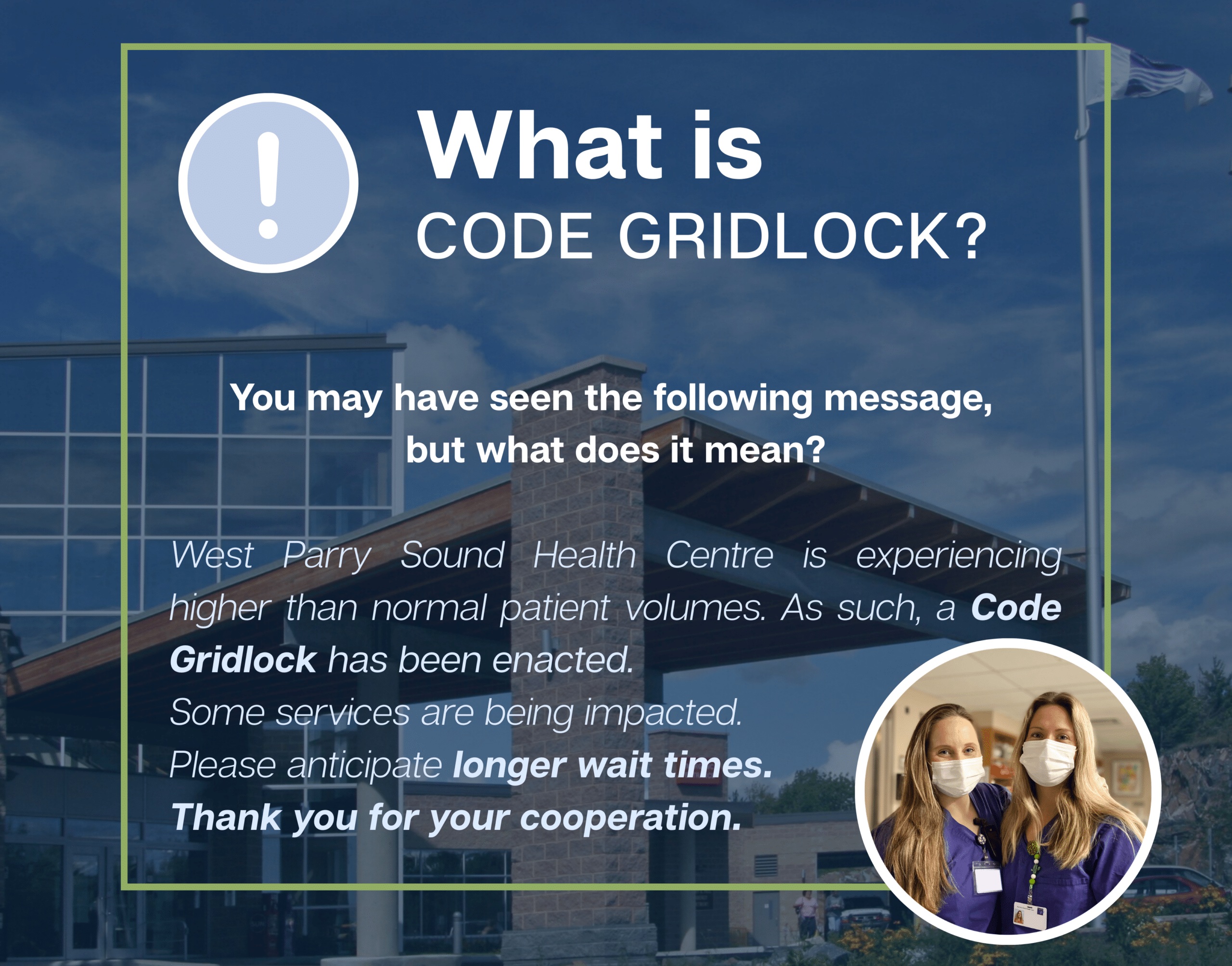
You may have seen or heard West Parry Sound Health Centre (WPSHC) declare Code Gridlock over the past year; but what does this mean, and how does it affect you?
At hospitals across Canada, and around the world, codes are declared to communicate important information to staff, patients, visitors, and families. These codes are most often heard over the public address (PA) system, or shared on social media. They may also be communicated through other means, such as email, website updates, and the news.
Hospitals use codes to ensure clear, efficient communication. In a health care setting, the ability to convey information accurately and quickly is critical to patient outcomes. The precious seconds saved by using a code, rather than describing a situation in full, can make all the difference.
For example, in the event of a fire, our teams announce, “Code Red, Location.” This provides staff with the essential information they need to respond. They can evacuate if necessary, attend to fire safety systems, proceed to the relevant location, and, where appropriate, escalate the matter to fire services. The additional time it would take to say, “There’s a fire in this location; will the following teams evacuate; will these individuals respond,” could prove critical.
At WPSHC, we operate with two types of codes: operational and clinical. While most codes fall into one category or the other, some involve elements of both. Code Gridlock, one of the most frequently declared codes, is an operational alert.
What is Code Gridlock?
Hospitals provide care based on two key factors: acuity (a patient’s care needs), and capacity.
While WPSHC would welcome an unlimited number of beds, and an equally limitless supply of care providers, our resources are not endless. As a result, care teams must prioritise the most urgent and life-threatening concerns. This may mean assessing one patient before another, allocating space in the Emergency Department, scheduling treatment, or admitting a patient to an inpatient unit.
When no inpatient beds are available, patients must continue to receive care and monitoring until one becomes free. This can mean longer waits for others who also require admission.
If the number of patients exceeds the hospital’s capacity, or if care needs require more resources than are available, Code Gridlock may be declared.
Code Gridlock means the hospital has reached maximum capacity. In some cases, this may mean operating at 120 per cent capacity. Patients in the Emergency Department may experience delays in seeing a physician if doctors are caring for other patients, or if there is no available treatment space. Ambulance offload delays may also occur, as arriving patients may have nowhere to be transferred within the hospital.
Why is Code Gridlock declared?
Declaring Code Gridlock ensures all team members are aware of the operational pressures facing the hospital, including those who are off duty. Where possible, additional staff may be called in to provide support where it is most needed. Teams also explore appropriate alternative care spaces. For example, a day clinic bed may be repurposed to accommodate a patient requiring urgent attention. Housekeeping staff may prioritise and expedite room cleaning to allow new admissions as quickly as possible. Care partners and other health organisations may also be notified to prepare for incoming or discharged patients.
The goal of Code Gridlock is to optimise operations, reduce bottlenecks, and ensure WPSHC continues to provide high-quality, comprehensive care to the patients, families, residents, and visitors of West Parry Sound.
How does Code Gridlock affect you?
When alternative spaces are activated and additional staff are redeployed to manage urgent situations, previously scheduled appointments may be postponed. Staff, physical space, or equipment may not be available for less urgent cases during a Code Gridlock.
Code Gridlock also typically results in longer wait times for patients with non-urgent concerns. Visiting the Emergency Department for a non-urgent issue during a Code Gridlock may mean significantly extended waits.
What can you do?
If you have an urgent health concern and are able to travel safely, please come to the Emergency Department.
If you require immediate assistance, call 9-1-1.
For non-urgent medical advice, contact Ontario 8-1-1. You may also use the North East Virtual Care Clinic.
If your concern is not urgent, please consider contacting your primary care provider, calling Ontario 8-1-1 for guidance, or booking an appointment with the North East Virtual Care Clinic.
A list of alternative care resources is available on our website. If you are unable to avoid a visit to our Emergency Department, please use our ED wait-time tracker to check current conditions before arriving.
WPSHC is privileged to serve the patients, residents, and families of West Parry Sound. Ensuring the best possible health outcomes for our community requires a collective effort. Your understanding, cooperation, and continued support are sincerely appreciated.